
Prolevity james@prolevity.ai

Digital infrastructure for founder-led businesses that need things to actually work.

Twenty-five years building software for companies in industries that were new to us at the start: airports, banks, agriculture, consumer electronics, defense. The work is usually the same shape. The business has grown past the systems running it, the information is scattered, and the person who understands how it fits together is the founder. Prolevity is where that work happens now.

A small number of engagements a year.

Agriculture Growers Express, Green Giant Fresh

TrueTrac

Growers Express farms thousands of acres of leafy greens across California and Mexico. Two problems, and they turned out to be the same problem.

The planting rules lived in the heads of individual senior farmers. What to plant, where, when, against which conditions and which customer commitments. Nobody had written it down and it was not obvious that it could be. Traceability was manual. When contamination surfaced anywhere in the produce industry, recalls swept up whole categories because nobody could link a package on a shelf back to a field and a date.

Between 2007 and 2009 we sat with the farmers and worked the knowledge out into rules a system could run, so planting could be scheduled against real customer demand instead of reconstructed each season from memory. Then we built the traceability layer: field-level reporting for HACCP, Good Manufacturing and Good Agricultural Practices, with an identifier carried through to the carton.

The same identifier opened a report written for whoever bought the bag. It named the grower and the ranch, showed the field on a map, carried the grower's own notes on the harvest, and graded the crop on colour, appearance, texture and packing. A bag of romaine could tell you who grew it.
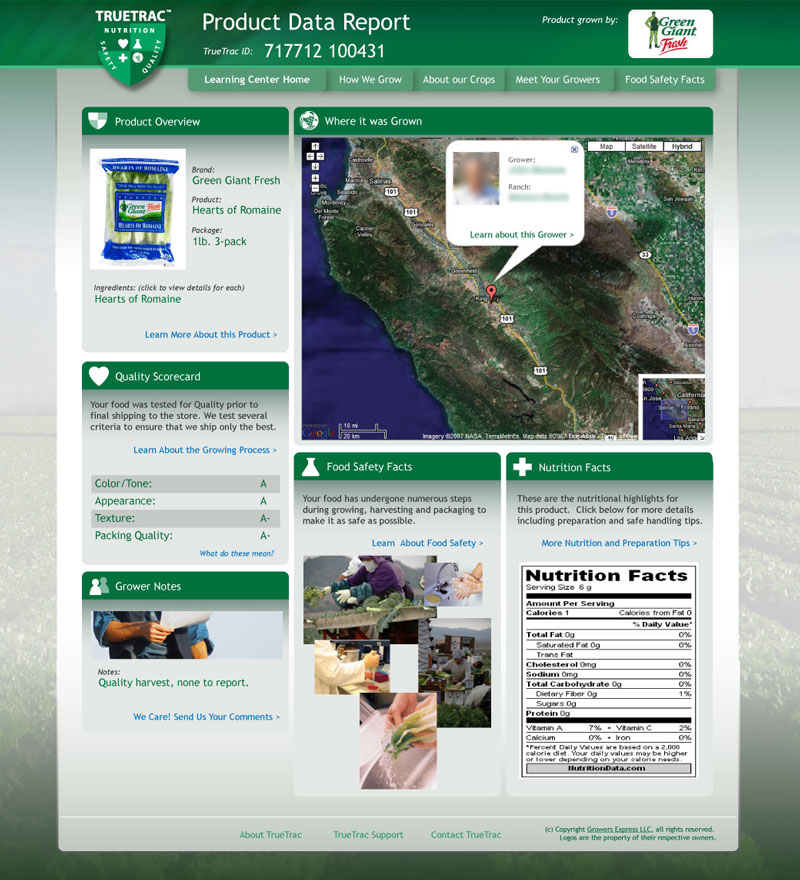
The TrueTrac Product Data Report for a 1lb three-pack of Green Giant Fresh hearts of romaine, showing the growing location on a satellite map, a quality scorecard, grower notes, food safety information and nutrition facts.
The consumer-facing Product Data Report. The grower's name and photograph are blurred here.

Growers Express piloted it and then rolled it out. By 2010, most of their branded domestic cartons were labelled to Produce Traceability Initiative best practices, and the president of the Produce Marketing Association cited the implementation as a model for other companies building on GS1 standards.

Reported by Growing Produce. The work was filed as US patent application 2011/0016144, naming James Goudy, Jamie Strachan and Alejandro Argueta as inventors, assigned to Growers Express. The application was abandoned in 2012. It has since been cited by fourteen patents, including filings from Kubota, CNH Industrial and Farmobile.
Defense 129th Rescue Wing, California Air National Guard

Command dashboard pilot

A search and rescue wing whose operational data sat in legacy systems and reached commanders once a week, exported into Excel, Word and PowerPoint for a briefing. Decisions about aircraft availability were being made on data that was days old. Staff spent their time formatting slides rather than reading what the slides said.

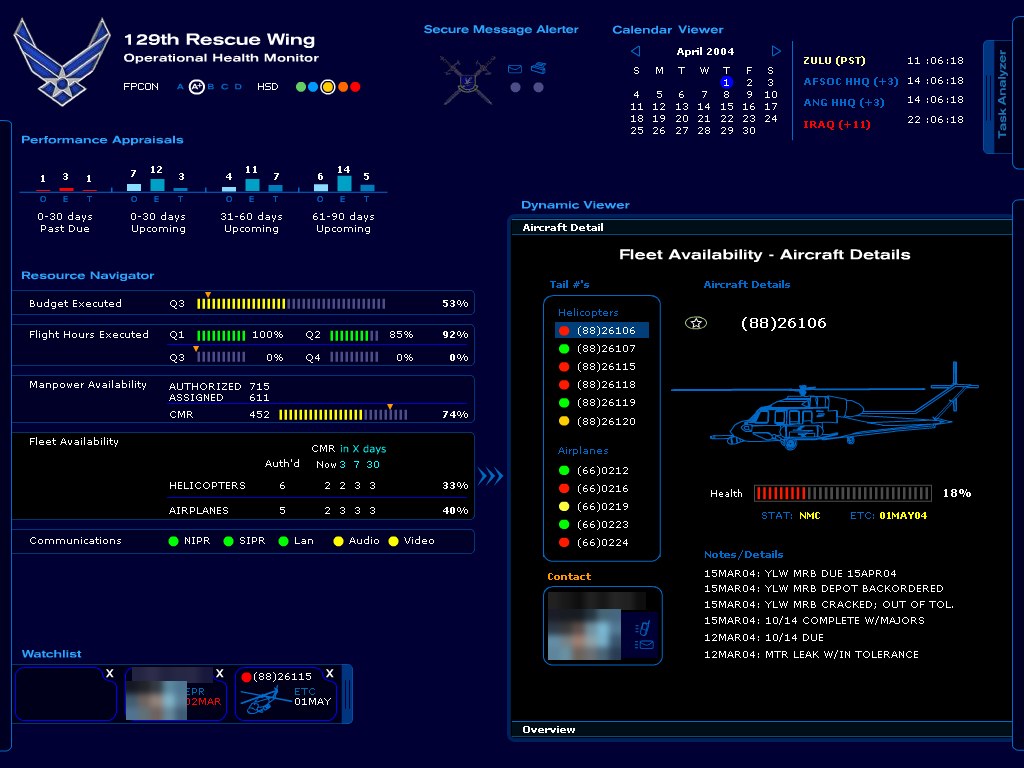
We built the pilot with Macromedia. A rich internet application that put budgets, personnel, communications, fleet availability and tasking on one screen, running on sample data so the wing could see what a live command picture looked like before committing to building one. It read from the legacy systems as they were, on the infrastructure already there, with no database integration required.

The wing's director of personnel described the approach as "shaving hours off decision cycles". Macromedia published the work as one of six government case studies in its 2005 white paper, alongside NAVAIR and the Miami-Dade Police Department.

The pilot interface: an operational health monitor showing performance appraisals, budget and flight hours executed, manpower availability, fleet availability by tail number, and an aircraft detail panel with maintenance notes.
The pilot, running on sample data. Names and faces are blurred here.
Airports Unibail-Rodamco-Westfield

Airport commerce platform

Travellers stop spending money once they are near the gate, because they are watching the board. Airport websites were digital brochures. Flight data, terminal maps and restaurant point-of-sale systems lived in separate systems that had no reason to know about each other.

We built the Shop and Dine platform for URW's airport properties: the front end travellers use and the orchestration layer behind it, integrated with airport authority data feeds for live flight information. One cloud codebase, one place to manage the concessionaire directory and the terminal maps for every airport, rather than a separate build each time.

Then in spring 2020 the passengers stopped coming, and the ones who came would not touch anything. Ordering had to exist, and it had to exist immediately. Because the directory, the maps and the terminal data were already central and modular, the commerce layer was something we could add rather than start.

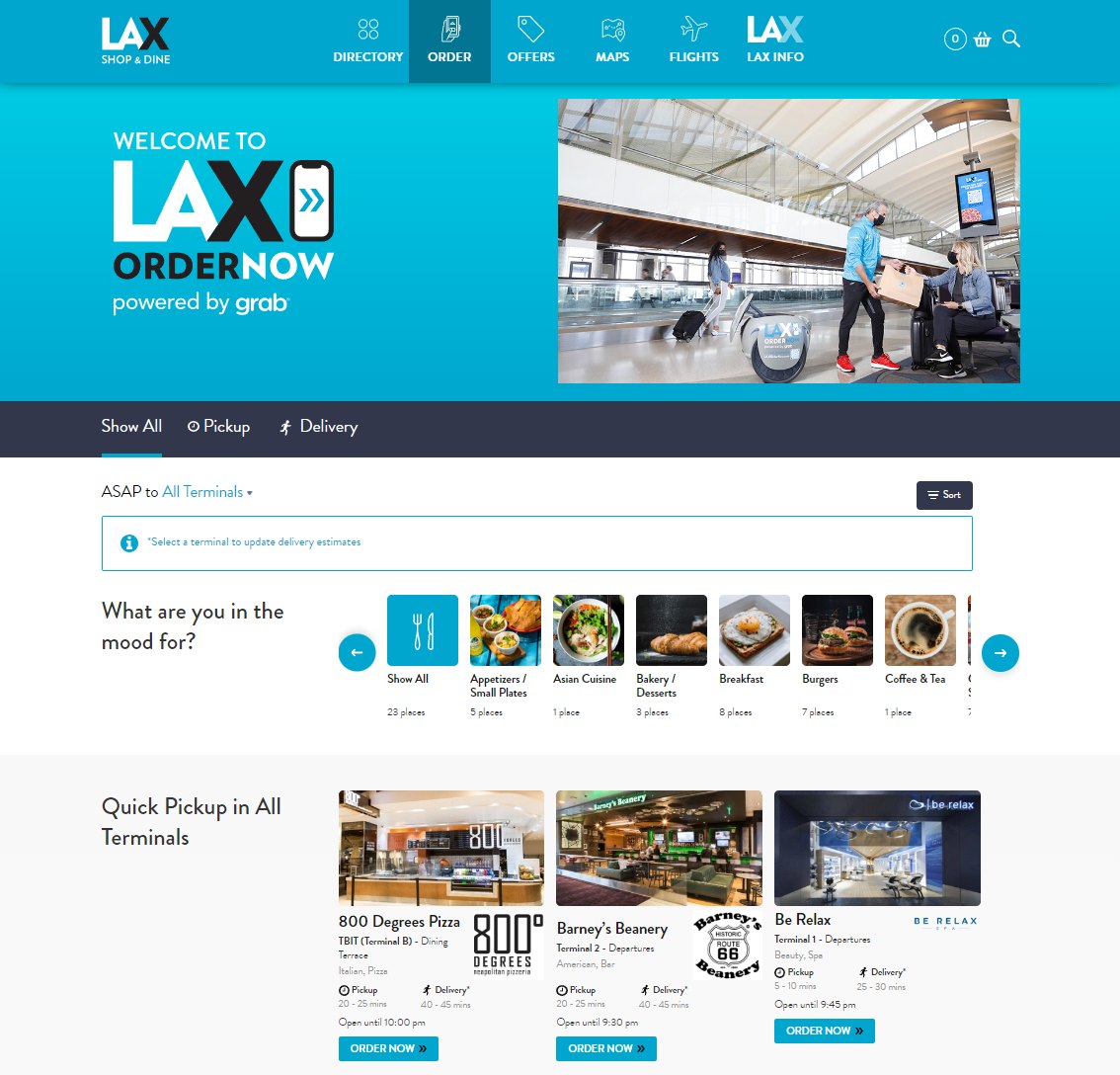
LAX Order Now went live on 1 October 2020, built with Los Angeles World Airports and Grab. No app to download, QR codes through the terminals, more than twenty restaurants at launch, and participating concessionaires across seven LAX terminals rather than only the ones URW managed. MIA2GO opened at Miami International seven weeks later. O'Hare's version reached every terminal by August 2023.

Dubai followed in October 2021, where the platform carried duty free alongside food and would deliver to the gate or the lounge rather than only to a pickup counter. Adelaide came in April 2022. Seven international airports in all: LAX, MIA, ORD, JFK, DXB, CPH and ADL.

The LAX Order Now screen inside LAX Shop and Dine, showing pickup and delivery tabs, a terminal selector, food categories with the number of places in each, and restaurant cards with pickup and delivery times.
LAX Order Now, running inside the Shop and Dine platform.

Launches reported by Los Angeles World Airports, Miami International Airport, ABC7 Chicago and Dubai Airports.

Municipal government City of Concord, California

Procurement requirements wizard

Finance staff were drowning in email threads and chasing departments for missing documents. Threshold laws changed every year, and the changes did not reliably reach the people submitting requisitions. A contract could reach signature without the insurance waiver it needed, because nothing in the process stopped it.

In 2022 and 2023 we built the front door. A logic engine works out which documents a request needs, based on dollar amount and vendor type, and fills the city's official forms automatically. The gate does not open until everything required is attached.

Finance stopped chasing paperwork. Requests now arrive with the documents already on them.

Financial services Charles Schwab & Co.

Schwab TV

In 2000, Schwab's retail branches were merchandised on paper. Corporate would make a plan, roll up the posters and brochures for every branch, and ship them out with instructions. Rates were changed by hand on numerical boards or ran across a simple ticker. Events were photocopied. None of it was connected to anything, and none of it moved.

Schwab and SOM had the concept for what would replace it: the integrated Investment Center. Schwab hired two of us to work with SOM on the display side of it. One to design the front end of the branch merchandising platform and the content that would run in the branches, the other to design the engine that captured the data and drove the animated sequences.

They set us up in the middle of the Crocker Galleria, behind blank white glass with restaurants either side. Unmarked, keycard access, full of displays and servers. Four first-generation plasma panels arranged edge to edge as a configurable billboard, an 18-inch touchscreen totem, and a 50-inch display we called Schwab TV. The panels came direct from Panasonic in Japan. They were the first any of us had seen in person, and they were wildly expensive.

The billboard ran templated animated sequences fed with market data and promotional content from the platform, and with each branch's own customer events. Displays inside the center ran data-fed content as well, and the totem invited customers to touch it.

A few months later we presented it. Leadership came in, watched it run, asked a couple of questions, and thanked us. Word came back afterwards that New York was going ahead.

The Investment Center redesign was an SOM programme, prototyped at the 300 Park Avenue and Rockefeller Center flagships. SOM’s own project record described the interior design reaching more than 200 retail spaces. Our part, the display system, ran at Park Avenue for a few days in early September 2001. We do not know whether it ran anywhere after that. This work was done independently, before Aviamedia existed.

Municipal water San Francisco Recreation and Parks Department

Integrated water control system

In 2007, Golden Gate Park and the San Francisco Zoo ran a scattered set of autonomous water control systems. Each one was an island. Where a site had a dashboard at all, it was antiquated and tied to the terminal, so reading it meant standing in the pump station. To find out how much water was in a reservoir, someone drove there and dipped a stick in it.

Most of those trips found nothing wrong. The ones that found something wrong often found the wrong thing, because staff left the yard without knowing what had failed and arrived without the right parts.

The controllers were Siemens, and they offered no convenient way in. We worked out the machine-level protocol they spoke, decoded it, and normalised what came back into one schema.

On top of that we built a central system that put every site in one place. Live pump RPM, reservoir depth, pressure and flow, on any browser. Secure write-back so authorised staff could start and stop pumps and change setpoints without driving anywhere. Automated alarms by email. And a SQL history replacing the dot-matrix usage logs, so patterns became visible for the first time.

The point was not the dashboard. It was that a truck rolled when something was actually broken, and arrived with the right tools.

Offshore drilling Check6

Electronic permit to work

On a drilling rig, a paper permit is carried between supervisors by hand. Nobody can see all the active hot work and confined-space permits at once, which on a rig is the thing you most need to see. Crews wait hours for a physical signature. And international crews read safety procedures in a language that may not be theirs.

Between 2010 and 2012 we built the permit system as a state machine. Under construction, pre-activation, active, suspended, resumed, with the transitions enforced, so work could not begin without the exact approvals and the system would not allow an unsafe jump between states. Role-based queues put the right permit in front of the right certified person rather than a generic inbox. A dual-language architecture carried English and Portuguese for equipment names and warnings without breaking the underlying data relationships.

The output was a live view of every active hazard on the rig, by location.

How we work

We start by sitting with the people doing the work. Most of what matters is not in the brief, and it is rarely written down anywhere. By the time we start designing, we usually understand the business well enough to ask the questions nobody there has thought to ask yet.

Also

James now spends most of his time on Trackable Systems, which builds independent forensic verification for solar assets.

Contact